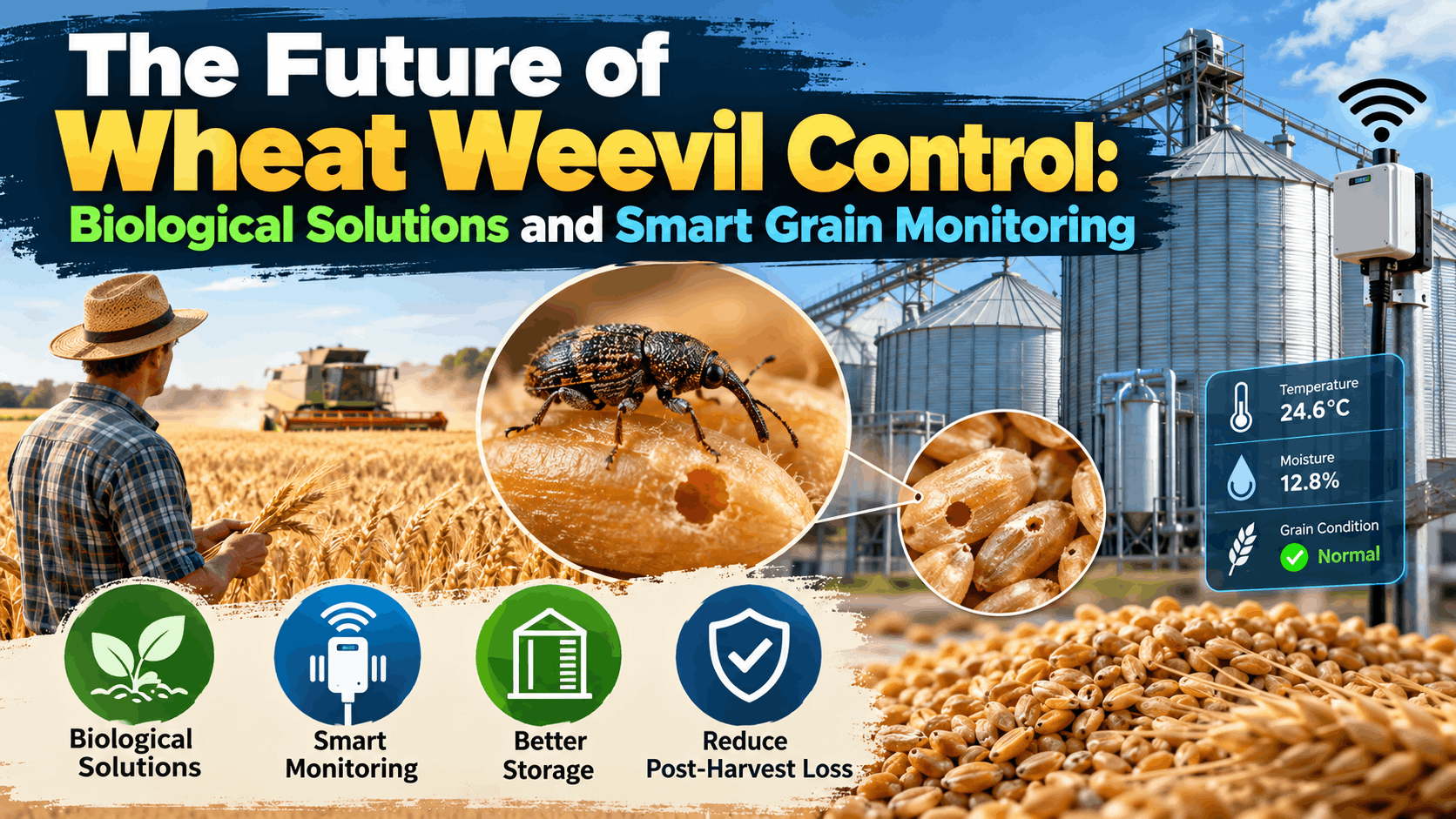
So far, the wheat season looked like a good one for Paul Jackson, the farmer. In Northern France his crop had grown satisfactory, wheat grains were quite healthy and the harvest was satisfactory. The issue came up at a later time.
Following wheat being taken into storage, small holes started to develop in the wheat kernels. Newly deposited fine grain dust collected around the bags and containers and by the end of the first couple of weeks the grain stored became infested.
It has not been the field that was not the problem. Now the battle was about to rage over the storage environment.
Hidden threat of wheat weevils
Weevils of stored wheat grains are destructive insects especially the granary weevil (Sitophilus granarius). The adults lay eggs in individual kernels and the growth larvae feed inside of the grain. Most of the adult’s development takes place in the kernel making an early detection of infestation challenging.
Eventually, damaged kernels, holes or residues in the grain surface are visible, but by then populations may be started.
This is one reason why the application of wheat weevil management can not end at harvest. After the combine leaves the field is critical to grain quality.
Post Harvest Loss: A Bigger Picture
Losses from grain range greatly depending on the type of grain, the geographical area, storage methods, pest burdens, condition of moisture and temperature at the time of storage, and handling of grain. In total, FAO estimated the loss of food was 13.3% in 2023, at the postharvest stage on-farm and up to retail (storing, transporting, wholesale and processing). The loss for cereals and pulses was an estimated 8.4%, for the crop specifically. Thus the states refer to a variety of causes and commodities, not just wheat weevil control, but the statement illustrates how important economic post harvest management of commodities is.
Losses to wheat storage are also variables that can be demonstrated by historical documentation of FAO. Average losses on storage for insects and moulds in one Pakistan assessment were 3.5% and there were significant variations in insect losses at certain points of storage, respectively.
A comparatively small loss can amount to a huge financial loss if it is converted to an annual commercial harvest for farmers like Paul.
The significance of storage conditions
Prevention of wheat weevils may not always be considered the first line of defense. A storage facility that will make pest problems and grain loss less of a problem.
The proper drying of grain prior to storage and prevention of moisture migration is important. More attention must be given to temperature and aeration, cleanliness and condition of storage structures. Check routinely for changes which may foreshadow a problem before it spreads.
Significantly, grain-storage resources include promoting improved post harvest management and commercialising appropriate storage technologies as key elements regarding grain loss reduction, an activity assigned to FAO.
The question now became “How do I identify and prevent a weevil situation from being a costly problem—before I get one?” for Paul.
Smart Grain Monitoring to add an Early Warning System
There are ways to make this transformation possible, such as modern storage systems. Maintaining temperature, moisture monitoring, periodic grain examination and automated notification can aid in noticing indications of deterioration and building pest situations.
Monitoring is NOT a substitute for pest control. Rather, it delivers data for those looking at farming and grain management to take action sooner.
If there was a sudden change in temperature in a stored grain for instance, it should be investigated. Inner moisture also can cause adverse moisture conditions in a specific area which can affect gradeability.
The concept is simple: measure, act, and keep one’s head under control if an issue is limited to a small area before it spreads throughout the entire storage area.
The place of biological control within the programme
Another area in which biological pest-management technologies are being integrated into a greater debate on sustainable agriculture is in the realm of genetics.Within the field of genetics, biological pest-management technologies are also coming into play in the broader discussion of sustainable agriculture. Metarhizium anisopliae biocontrol is an entomopathogenic fungus which enters susceptible insects via contact with spores.
Spores settle on the insect’s cuticle, germinate and grow inside the insect. This is a unique mode of action from conventional insecticides, which have a chemical action.
There is one important difference from the grain producer point of view, however: a soil- and surface-active product should not be touted as a wheat-stored and/or wheatweevil treatment. The target pests, formulation and application environment for its approved use must be in accordance with its product label.
Met Zone, Protecting the Crop Before Storage
There is the best insecticide for weevils, like Met Zone, that take up more of a specific role here. Met Zone is a granular biological insecticide that is positioned for soil and surface pests such as wireworms, cutworms, white grubs and root weevils by one of the brand owners, Novobac.
It has therefore a major relevance to a wheat production system, apart from being directly applied as a control for the purpose of treatment in the stored grain, as a granary weevil.
Novobac also offers a biological insect control active ingredient – Metarhizium anisopliae active in powder and granular formulations. We will then provide you with product information and answer any questions you might have.I will then give you information about the product and address your questions.
Biological soil pest management (BSPM) is an effective component of an IPM program which is used to successfully lower pest pressures prior to harvest when used in accordance with its approved label.
The future is an Integrated System
In the 21st century, Paul’s experience demonstrates the crucial shift to modern protection of grain. Pest management is no longer just a field operation and harvesting. It is a “whole farm” approach that links together good farm practices during crop cultivation, harvesting, storage, monitoring and early action.
Biological products can play a role for field pest management; smart monitoring and appropriate grain storage technologies can play a role protecting the grain after harvest. Both should NOT be promoted as a “f Fixed” to replace traditional controls; rather, both will have a specific purpose in a program of control.
From Field to Store
The single step that has proved to be most useful is the simplest: protection of wheat does not end when it exits the field.
The keys for the farmer in the management of pests during the grain production, careful harvesting, proper moisture / temperature drying of grain, clean grain storage and regular inspections of grain storage.
The battle against weevils in wheat production is likely to become more about integrated biological control plus diligent grain monitoring and effective storage management than about a single “best” management strategy successful in the past.
Everything started off fine for Paul with healthy wheat in the field. The new generation of grain protection will ensure attention is provided right up to the storage bin.