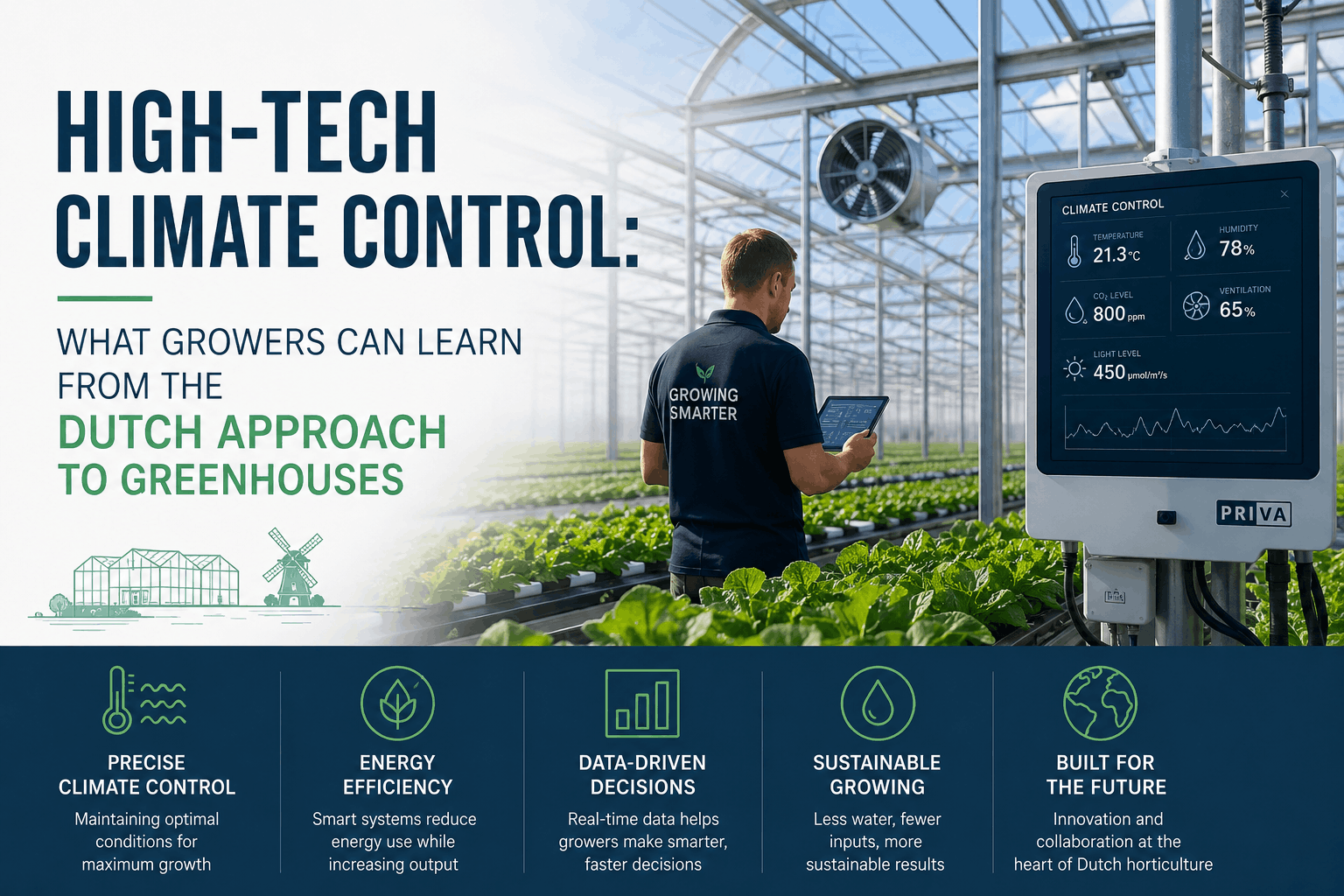
Climate control is the difference between a greenhouse that simply protects a crop and one that actively pushes it toward higher, more consistent yields. Growers in the Netherlands have spent decades refining this, and their approach has shaped how high-tech greenhouses are built around the world. This guide breaks down what climate control actually involves, why the Dutch method works, and how you can apply the same thinking to your own operation, whether you are running a polyhouse today or planning a larger commercial build.
The answer at a glance
If you only have a minute, here is how the three common greenhouse types compare on climate control and what each one is best suited for.
| Greenhouse type | Climate control level | Typical use | Yield consistency |
|---|---|---|---|
| Naturally ventilated (basic polyhouse) | Passive: roof/side vents, manual shading | Beginners, mild climates, lower-value crops | Low to moderate |
| Semi-closed greenhouse | Active: mechanical ventilation, cooling, air treatment | Growers scaling up, variable climates | High |
| Fully climate-controlled (high-tech) | Integrated: temperature, humidity, CO2, light, irrigation managed together | Commercial year-round production, high-value crops | Very high |
Rule of thumb: the more variables you control together rather than one at a time, the more stable and predictable your harvest becomes.
What climate control in a greenhouse really means
A greenhouse climate is not a single setting. It is the combined result of several factors that constantly influence each other. When you change one, you affect the rest. The Dutch approach treats these factors as one connected system rather than separate problems to solve in isolation. The main elements are:
- Temperature: keeping day and night temperatures within the range your crop needs to grow and set fruit.
- Humidity: managing moisture in the air to support transpiration while avoiding fungal disease.
- Ventilation and air movement: refreshing the air and distributing temperature and humidity evenly across the crop.
- CO2 enrichment: raising carbon dioxide levels during daylight to accelerate photosynthesis and growth.
- Light: supplementing natural light when days are short or cloudy so the crop keeps producing.
- Irrigation and root-zone climate: matching water and nutrient delivery to what the plant is transpiring.
Managing these together is what separates a high-tech greenhouse from a simple covered structure. A climate computer reads sensors across the greenhouse and adjusts vents, screens, heating, cooling and CO2 dosing automatically, often making small corrections many times an hour.
How the key elements work together
Temperature and humidity
Temperature and humidity are closely linked. Warm air holds more moisture, so heating, ventilation and screening all influence humidity at the same time. Growers manage this balance using the concept of vapour pressure deficit, which describes how much more moisture the air could hold. Keeping that deficit in the right range encourages healthy transpiration without inviting condensation and disease.
CO2 enrichment
Plants use carbon dioxide during photosynthesis. In a sealed or semi-closed greenhouse, CO2 is quickly depleted on a bright day, which slows growth. Dosing CO2 back up to the right concentration during daylight hours is one of the most cost-effective ways to lift yield, provided the rest of the climate is in balance.
Light and energy
Supplementary lighting extends the productive day and stabilises output through darker months. Because lighting and heating both consume significant energy, the Dutch approach increasingly pairs them with energy strategies such as heat buffering, screens that retain warmth, and in some projects geothermal heat. The goal is to deliver the climate the crop needs while keeping running costs under control.
Why the Dutch approach became the global benchmark
The Netherlands has limited land and a cool, cloudy climate, yet it is one of the largest exporters of greenhouse produce in the world. That apparent contradiction is exactly why Dutch growers and builders focused so heavily on technology. With few natural advantages, they had to engineer the growing environment instead of relying on the weather.
Three principles define the approach and they translate to almost any climate:
- Integration over isolation. Every system, from screens to irrigation, is controlled as part of one climate strategy rather than independently.
- Data-driven decisions. Sensors and climate computers replace guesswork, so adjustments are based on what the crop is actually experiencing.
- Efficiency by design. Energy and water are treated as costs to optimise, which keeps high-tech production profitable rather than just impressive.
Applying these lessons to your own greenhouse
You do not need a fully automated facility on day one. The value of the Dutch method is the order of priorities, which works at any scale. Use the table below as a practical starting point depending on where your operation is today.
| Where you are | Where to focus first |
|---|---|
| Just starting out | Get ventilation and shading right before anything else. Stable temperature and good air movement deliver the biggest early gains for the lowest cost. |
| Scaling up | Add active climate control and basic monitoring. Introduce CO2 dosing and humidity management once your structure can hold conditions reliably. |
| Going commercial | Integrate all systems under a climate computer and plan energy strategy from the start. This is where partnering with an experienced builder pays off most. |
The jump to a fully integrated, climate-controlled greenhouse is also where the engineering becomes genuinely specialised. Designing a structure, climate system, irrigation and energy plan that all work together for a specific crop and location is a different discipline from putting up a polyhouse. This is why large commercial growers, including those building in demanding climates, often work with dedicated specialists rather than assembling systems piece by piece.
For example, a greenhouse builder New York growers turn to brings exactly this integrated approach to a region with cold winters and hot summers, where passive climate control alone simply cannot deliver year-round production. The same principles that make Dutch greenhouses productive in a cloudy northern climate are what make high-tech production viable in challenging conditions anywhere.
Key takeaways
- Climate control is a system: temperature, humidity, ventilation, CO2, light and irrigation all influence each other.
- The Dutch approach succeeds because it integrates these elements, relies on data, and designs for energy efficiency.
- Start with ventilation and shading, then layer in active control and CO2 as you scale.
- For fully integrated commercial greenhouses, the design and engineering are specialised, which is why experienced builders are worth involving early.
Climate control is not about buying the most equipment. It is about controlling the right variables together so your crop gets a consistent environment every day of the year. That is the real lesson worth borrowing from the Dutch.