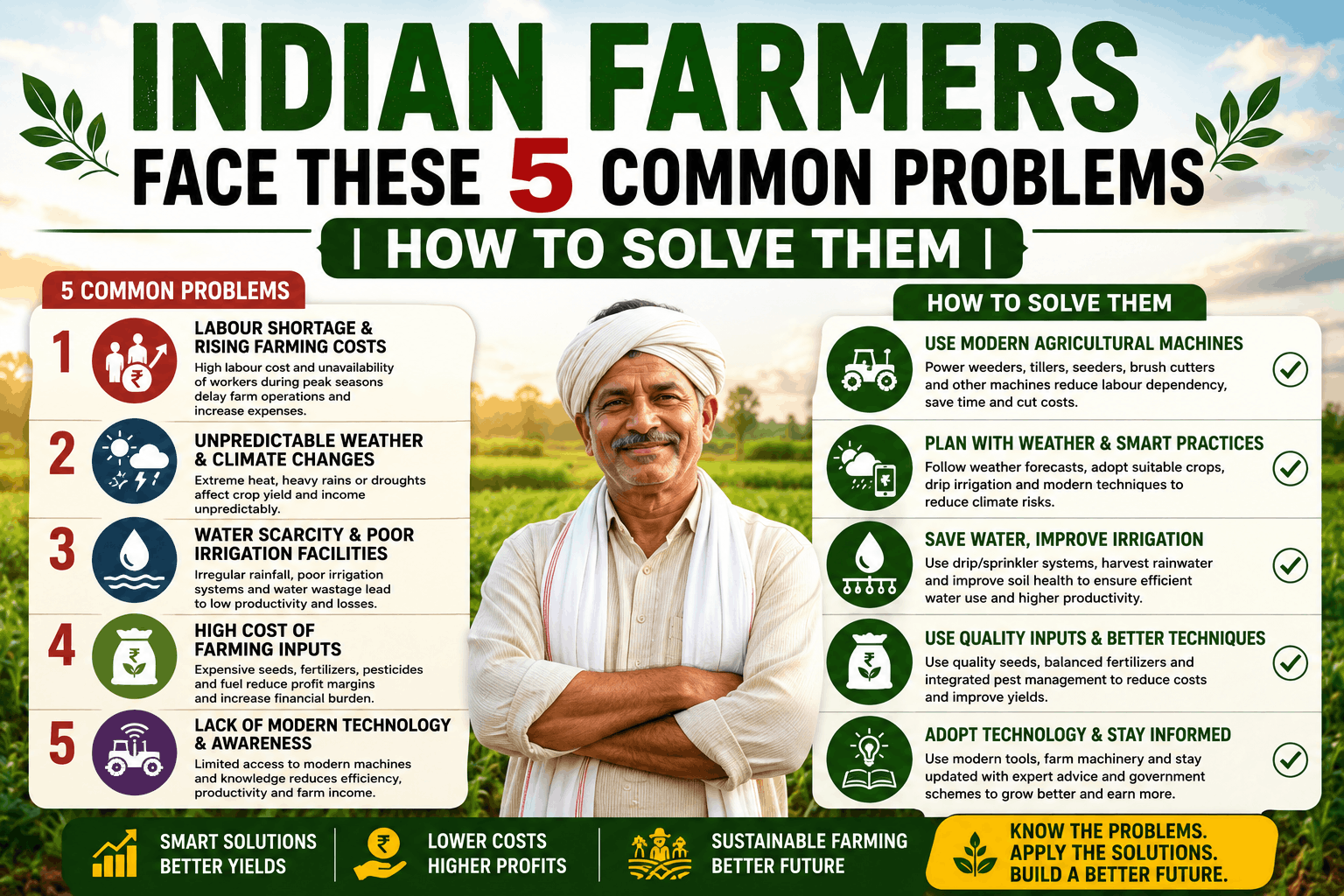
Indian agriculture has been the foundation of the country, but farmers in India still have numerous challenges every day that impact their income, productivity, and peace of mind.
Farmers have to deal with a lot of problems. These problems include labour cost, variable weather, water shortage, high farming input cost, and shortage of modern technology.
Farming is harder because of these issues. Farmers across India face these issues all the time. They make it tough for Indian farmers to get what they want, even when Indian farmers work hard all year.
The good thing is that farmers across India can deal with these issues if they have the knowledge and smart farming practices and new agricultural technologies.
In this article, you will read about 5 common issues that farmers across India face and some practical solutions to address these issues and make farming easier, more productive, and more profitable for Indian farmers.
5 Most Common Problems Faced by Indian farmers and the Need for Smart Solutions
Indian farming has changed a lot over the years. The problems that farmers face are getting worse really fast.
Farmers have to deal with a lot of things, like growing crops. They also have to worry about not having enough people to help them with the crazy weather, not having enough water, spending too much money on farming, and not being able to use the latest farming tools.
All these things can make it harder for farm owners to grow crops. It can even make them poor. This is especially true for medium-scale farmers across India.
So many Indian farmers are using farming and the latest farming tools to save time, do less manual work, and get more done.
By understanding the problems that Indian farmers face, they can figure out how to make their farming better in India and make it more efficient, productive, and profitable for farm owners.
- Labour Shortage and Rising Farming Costs
Indian farmers are facing a problem these days, and that is a labour shortage. There are no people to work on farms when it is time to sow and harvest crops. The people who are available to work are asking for a lot of money during these times.
This means that farming is becoming very expensive, and some important work on farms is getting delayed. This can affect the quality of crops. How much is grown?
To deal with this issue, many farmers are now using machines to work on their farms. They are buying things like power weeders, brush cutters, and seeders from companies like Balwaan Krishi. They are also using chaff cutters and mini tillers.
These machines are very helpful because they do a lot of the work that people used to do. They save time. Help get farming jobs done quickly.
Today’s farmers can use these machines to grow more crops and do their jobs more easily, which means they can also save money on things like labour and other costs.
Labour shortage is still a problem. These machines are making things easier for farmers. Labour shortage is an issue, but with the help of these machines, farmers can do their jobs better.
Key Solutions:
- Apply modern agricultural machines to decrease dependence on labour
- Select equipment that will save time and fuel costs
- Complete tasks on the farm more quickly in peak seasons
- Reduced the need for manual effort to improve productivity
- Apply smart farming practices for more efficiency and profitability
- Unpredictable Weather and Climate Changes
The weather is a problem for Indian farmers. The weather can be very different from one time to another. It can be very hot. There can be too much water or not enough water. This can really affect the crops and the amount of food the Indian farmers can grow.
If the weather is not good at the time, it can cost today’s farmers a lot of money.
The weather is an issue for the farming business. It makes it harder for Indian farmers to do their job for those who need rain to water their crops.
To deal with these problems, today’s farmers are now doing things differently. They are using ways to water their crops, and they are changing the way they farm based on the weather. They are also using machines that help them grow food even when the weather is bad.
Key Solutions:
- Apply efficient irrigation systems to water properly
- Listen to weather forecasts before important farming operations
- Select crops that can withstand temperature conditions and rainfall levels in that area
- Make use of modern farming techniques that minimise damage to crops
- Promote and monitor soil health for water holding capacity in dry seasons
- Water Scarcity and Poor Irrigation Facilities
Water scarcity is a problem for farmers in many places in India. In some areas, they depend on rain to water their crops, which makes it really hard to farm when it does not rain much or when there is a drought.
Farmers can lose a lot of money because their crops do not grow well, they get harvests, and they lose money because their irrigation systems are not good enough.
Water scarcity affects the farmers and their crops in a way.
Much water is also wasted because of the old ways of irrigating crops, which means more water and energy are used.
So farmers are slowly starting to use ways of irrigating their crops and new farming methods that help save water and grow better crops. Water management is very important for farmers to have a farm and to be able to keep farming for a long time. Managing water is crucial for farming and for the farmers.
Key Solutions:
- Avoid wastage of water by using drip and sprinkler irrigation
- Collect rainwater for future use in farming
- Prevention of unnecessary water waste in fields
- Add organic matter to the soil to help keep it moist for longer
- Make use of modern irrigation equipment to manage water better
- High Cost of Farming Inputs
The price of things that Indian farmers need to farm, like seeds, fertilizers, and pesticides, is going up. This makes farming very expensive for farmers. It is a problem for small farmers today because it affects how much money they can make from farming and if they can keep farming.
If Indian farmers use farming methods and smart machines, they can save money and grow more food. If they plan well and use what they have wisely, today’s farmers can also manage their farming expenses better.
Key Solutions:
- Use fuel-efficient farm machinery
- Don’t over-fertilize or overspray for pest control
- Manage farming activities efficiently to minimize waste.
- Invest in machines that have low maintenance and high durability.
- Adopt cost-effective farming practices for better profits
- Lack of Modern Farming Knowledge and Equipment
The thing is, a lot of farmers do not know about agricultural techniques and equipment. This is why many farmers are still using farming methods.
This can make farming a lot harder for farmers, as they have to put in manual effort, and it can delay farming operations. Farmers may also find it difficult to make their crops better and make money from their farm without the right tools and knowledge.
Farmers can be more efficient in their production. Get better yields by learning about the latest farming techniques and how to use the latest agricultural machines.
The availability of equipment and farm information is really important for making the farm more productive, and this is something that farmers need to know about modern agricultural techniques and equipment.
Key Solutions:
- Gain knowledge of contemporary methods and technologies in agriculture
- To increase the efficiency of advanced agricultural machines
- Participate in agricultural training and workshops
- Select machinery according to the farm requirements and land area.
- Keep abreast of new farming techniques and solutions
The Importance of Adopting Smart Farming Solutions
Smarter and more efficient solutions necessary for modern farming challenges. Nowadays, farmers using advanced agri-equipment and improved farming methods can save time, cut down on hard work, and enhance productivity generally.
Smart farming is not only useful in tackling day-to-day farming problems, but it can also help in the sustained development and profitability of farming.
Armed with the knowledge and tools, today’s farmers can make farming more productive, sustainable, and future-ready.
Upgrade Your Farming with Balwaan Krishi’s Smart Agricultural Solutions
Want to make your farming work easier, faster, and more productive? Farmers will be able to witness the power of the modern Agricultural machinery and smart farming solutions developed to address the needs of Indian agriculture with Balwaan.
Be it Power weeders & tillers, brush cutter or seeders Balwaan Krishi has all the reliable machines that help cut down on labour, save time, and improve farming efficiency.
Elevate your agricultural practices with cutting-edge solutions, ensuring sustained productivity and growth. Learn about Balwaan Krishi’s innovative farming tools today and make a smarter leap towards successful and profitable farming.
Conclusion
Labour shortage, water scarcity, high farming costs, and unpredictable weather are problems for farmers in India. But if farmers plan properly, use machines, and follow good farming practices, they can manage these issues better.
Farmers in India are changing the way they farm with efficient techniques to get more crops and reduce hard work. Using farming methods and modern technology can make farming good for the environment, increase crop yields, and help farmers earn more money.
FAQs
- What are the most common problems faced by Indian farmers?
Some of the most common farming challenges include labour shortages, water scarcity, rising farming costs, unpredictable weather, and a lack of modern farming equipment.
- How can modern agricultural machines help farmers?
Modern agricultural machines help reduce manual labour, save time, improve farming efficiency, and increase overall productivity in the field.
- Why is smart farming becoming important in India?
Smart farming helps farmers manage resources better, reduce farming costs, and improve crop production with the help of modern technology and equipment.
- How can farmers improve productivity in agriculture?
Farmers can improve productivity by using advanced farming methods, proper irrigation systems, quality equipment, and better crop management practices.