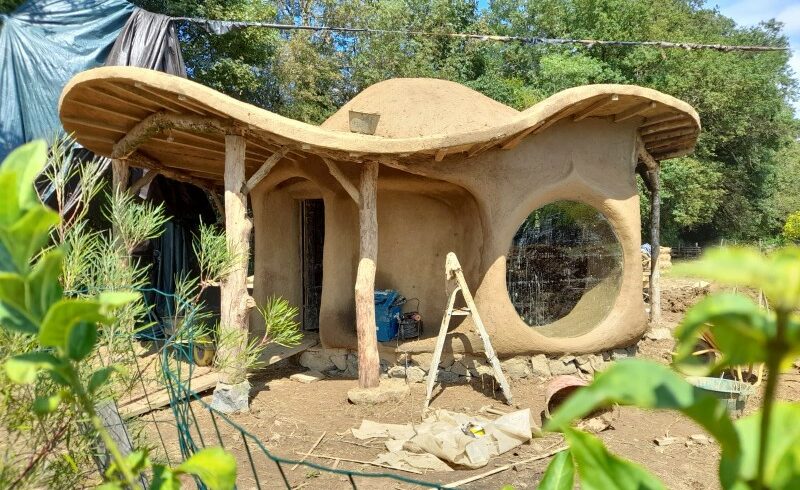
In the modern quest for luxury, we have largely traded the “living” earth for “dead” concrete. We live in boxes of steel and cement, relying on air conditioning to breathe and artificial filters to stay healthy. But as global temperatures rise, a critical question emerges: Is our modern construction actually making us sick and stressed?
We believe the answer lies in the ground beneath us. By comparing the thermal science and health impacts of mud versus concrete, it becomes clear that the most “advanced” home is the one that stays in harmony with nature.
The Science of Cool: Why Mud Outperforms Concrete
The most immediate difference you feel when stepping into a mud home is the drop in temperature, often 5°C to 8°C cooler than a conventional concrete building. This isn’t magic; it’s a combination of thermal mass and breathability.
1. Thermal Mass vs. Conductive Heat
Concrete and glass are highly conductive. They absorb solar radiation quickly and pump that heat directly into your living space. In urban areas, this creates the “Urban Heat Island” effect, where buildings hold onto heat long after the sun goes down, forcing your AC to work overtime.
Mud, however, has high thermal mass. It acts like a thermal battery. It slowly absorbs heat during the day but resists passing it through to the interior. By the time the heat finally reaches the inner surface, the sun has set, and the outside air has cooled. This “thermal lag” ensures your home remains at a stable, comfortable temperature 24/7.
2. The “Breathing” Wall
According to research, one of the greatest failures of modern concrete is that it is “vapour-tight.” It traps air and moisture. Mud is a porous material; it allows for a microscopic exchange of air, which naturally de-humidifies the room. This process, known as hygroscopic buffering, ensures the air never feels “stuffy” or “heavy.”
Mud vs. Concrete at a Glance
For those looking to balance sustainability with lifestyle, this table breaks down the essential differences between traditional mud construction and modern concrete.
| Feature | Mud / Stabilized Earth | Conventional Concrete (RCC) |
| Indoor Temperature | Naturally cool; stays 3–5°C lower | Heats up quickly; requires AC |
| Carbon Footprint | ~192 kgCO2e/m² (Low) | ~747 kgCO2e/m² (High) |
| Air Quality | High, natural humidity regulation | Risk of “Sick Building Syndrome” |
| Wall Breathability | High; prevents mold & mildew | Low; traps moisture & toxins |
| Acoustic Insulation | Excellent; absorbs sound | Poor; reflects sound (echoes) |
| Sustainability | Fully recyclable & biodegradable | Non-recyclable; ends in landfills |
The Health Impact: Beyond Just Temperature
Beyond temperature, the material of your home dictates the quality of the air you breathe every minute.
1. Preventing “Sick Building Syndrome”
Modern concrete construction involves a cocktail of chemicals: VOCs (Volatile Organic Compounds) in paints, chemical retardants in cement, and synthetic sealants. Prolonged exposure to these can lead to chronic headaches, fatigue, and compromised immunity.
Mud is non-toxic and hypoallergenic. When sourced locally, as its done in Sannidhi Eco Farms, it contains no off-gassing chemicals. It is a “biophilic” material that reduces stress and promotes a sense of psychological calm.
2. Natural Humidity Control
As noted by architecture experts, concrete traps moisture from cooking, showering, and breathing. This leads to high humidity, which is the perfect breeding ground for mold and dust mites, the leading triggers for asthma and respiratory allergies. Mud naturally regulates indoor humidity by absorbing excess moisture when the air is damp and releasing it when the air is dry, maintaining a healthy 40–60% range.
The Environmental Cost
You cannot be truly healthy in an unhealthy environment. The production of cement is responsible for roughly 8% of global CO2 emissions. To build a standard concrete villa, materials are often transported hundreds of kilometers, burning fossil fuels every step of the way.
At Swasya, Compressed Stabilized Earth Blocks (CSEB) are utilized. This reduces the carbon footprint by over 75% compared to conventional bricks and concrete. By choosing mud, you are ensuring that your sanctuary doesn’t come at the cost of the planet’s health.
Redefining Luxury at Swasya
At Swasya, mud is not a “primitive” material. It’s the ultimate luxury: the luxury of breathing clean air, sleeping in natural coolness, and living in a home that has a soul.
Swasya’s managed farmlands in Karnataka integrate Climate Responsive Architecture. Use modern engineering to give you the durability of a modern villa with the health benefits of an ancient earthen home. Imagine a home surrounded by Mahogany and Teak, where the walls are as natural as the trees outside.
Conclusion: Which One Truly Wins?
While concrete offers speed, it fails the most important test: the test of human well-being. A home should be more than a shelter; it should be a sanctuary that nourishes your physical and mental health. When you choose mud, you are choosing a lifestyle that values your health as much as the planet’s, supporting principles of sustainable agriculture and eco-conscious living that strengthen the bond between humans and nature.
FAQs
1. Is mud construction really suitable for modern living in India?
Yes. Modern mud construction in India uses engineered techniques like CSEB and rammed earth, making mud homes strong, comfortable, and very much modern.
2. What is the mud house construction cost compared to concrete houses?
Mud house construction cost is usually 15–25% lower than RCC homes, especially when local soil is used and long-term energy savings are counted.
3. Do mud homes last long or need frequent repairs?
Well-built mud homes can last decades, even centuries, with basic maintenance; many traditional mud house constructions in India prove this already.
4. Are mud homes really cooler than concrete homes?
Yes. Mud homes naturally regulate heat and stay 5–10°C cooler, unlike concrete homes that trap heat and depend heavily on ACs.
5. Is mud architecture safe during heavy rains or monsoons?
When designed correctly with proper foundations, plinth height, and roof overhangs, mud architecture performs very well even in heavy rainfall.